
Training game
Tic tac toe
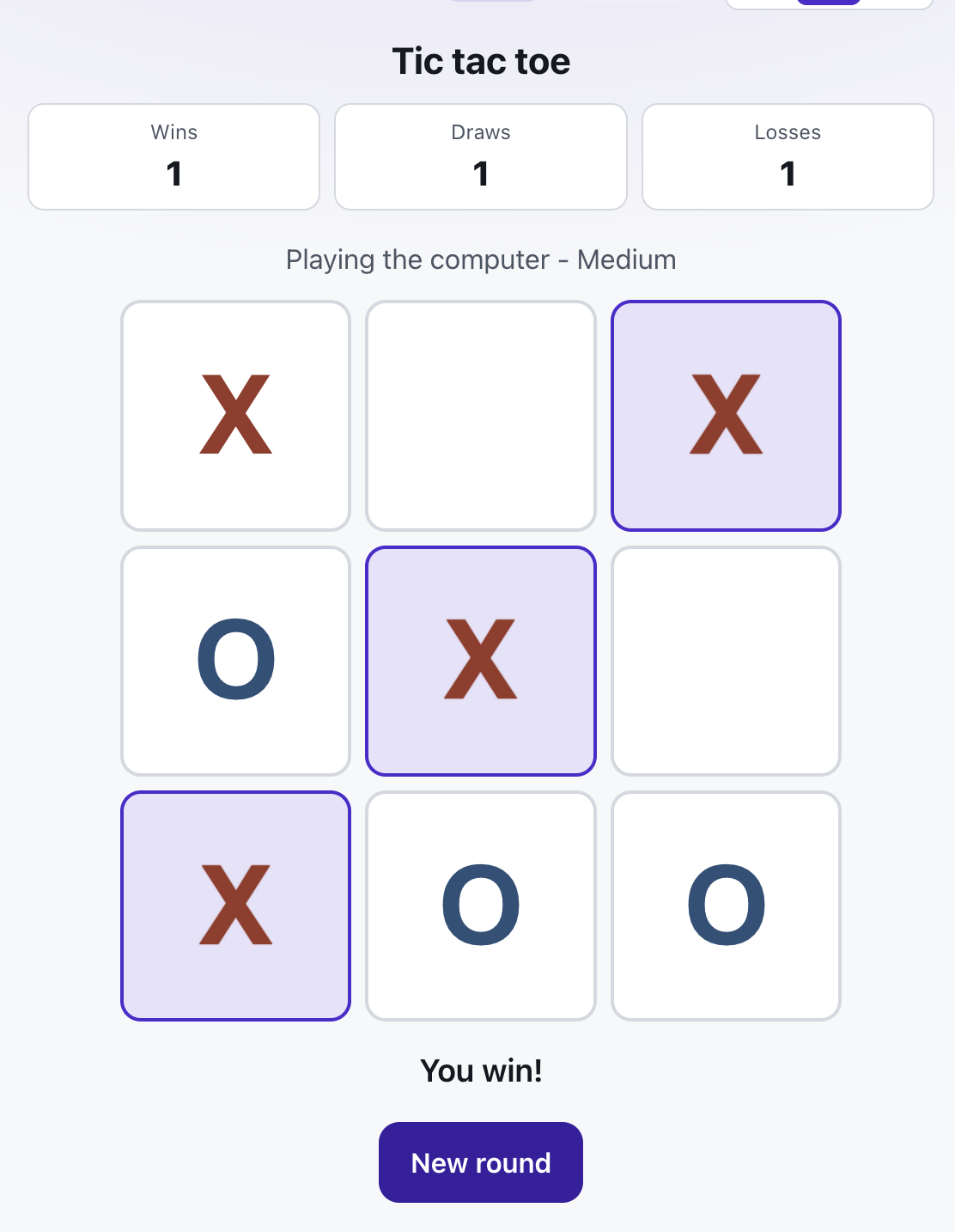
The classic everybody already knows, on the whole room’s phones - against the computer at three levels or in duels between participants. The hard level cannot be beaten, and that is where the interesting conversation starts.
What is the Tic tac toe game?
Tic tac toe is a solved game: when both sides play well it always ends in a draw. The hard level in Verbalu is a full minimax search, so it genuinely never loses - and the room can check that on their own phones in two minutes.
For the trainer it is the cheapest possible filler: one session, a code on the screen, no preparation at all. For the group it is a warm-up, an energiser, or the way into a block about strategy, about bottlenecks, and about when it is worth changing the game instead of playing harder.
See it in action
A well-played round ends in a draw
Features
Key capabilities
Three levels, three different games
Easy plays at random and goes down on the first try. Medium takes a win and blocks one, but never sees a fork. Hard is full minimax with alpha-beta pruning - the best anyone gets out of it is a draw.
Playable from the keyboard
The whole board is a single tab stop, the arrow keys walk the cells and wrap at the edges, Enter places a mark, and the outcome is read out by the screen reader. Nobody sits out because they cannot use a mouse.
Duels across the room
In duel mode participants pair themselves off: finish a game and you are handed the next opponent. The board is shared by both phones, and anyone waiting can play the computer meanwhile.
A live scoreboard
The trainer console ranks the room by wins, draws, losses and points. You can see at a glance how many people managed a draw against the hard level - and that nobody managed a win.
A round survives a reload
Every move is written to the session, so a locked screen, a reloaded page or a weak signal does not wipe the game. The participant comes back to exactly the position they left.
Step by step
How it works
Set the game up and start a session
Choose the opponent (the computer or duels), the level and who opens. Before you decide, try it on the practice board next to the settings.
Project the code
The console shows the code and a QR code. Participants join from their phones, anonymously, with no account.
The room plays
Rounds run themselves: who opens alternates, and each finished game offers the next one. You watch the score live and can change the level mid-session.
Talk about the result
Ask who beat the hard level. Nobody did - and that is the starting point for a conversation about unwinnable games, and about choosing the game rather than playing harder.
Use cases
What it’s good for
- A warm-up at the start of a training day, while the room is still arriving.
- A filler after a demanding block that needs no preparation whatsoever.
- The opening of a block on strategy, game theory and decisions under full information.
- An exercise in thinking one move ahead: spotting the double threat.
- A computing lesson: a live demonstration of minimax and of a solved game.
White label
Your brand for participants
On the paid plans you can add your company name, logo and colors, and during every session participants will see your brand instead of Verbalu.
Training by Octigo
Want this run as a full training?
You are free to run our games and simulations on your own. But if you would like us to deliver a complete training, with a professional debrief and the concepts behind the “Tic tac toe” simulation explained in depth, get in touch. Octigo is a professional training company with 20 years of experience and many awards for its simulations.
- 20 years of experience in corporate training
- Award-winning training simulations
- A professional debrief and takeaways after the session
- A programme tailored to your goals and your team
Prefer to write to us directly? szkolenia@octigo.pl
Try “Tic tac toe” in Verbalu
Create a free account and run your first engaging session today. No card, no installation.